WEARHAUS didn’t start as a brand deck. It started as two builders standing in a messy warehouse, squinting at the ceiling, and asking: “What if this space could travel?”
The Spark: Two Builders, One Warehouse
I’m b0gie. I build things — 3D stuff, code stuff, chaotic creative systems that shouldn’t work but do. A while back I linked up with 0xQuan, another builder who operates on the same wavelength: ship fast, iterate loud, don’t let perfectionism kill the vibe. We kept running into the same problem. The metaverse had plenty of museums — pretty static spaces you walk through once, screenshot, and forget. What we wanted was a venue. Something alive. Something that breathes, changes, hosts drops, and actually belongs to the people who show up.
That conversation happened inside a real-world warehouse. Concrete floors, bad lighting, the kind of space that feels empty and full of possibility at the same time. We looked at each other and basically said: let’s build this, but make it go worldwide. Not a copy of the warehouse — the spirit of it. Raw, unfinished, community-owned, builder-forward.
WEARHAUS was born right there. No pitch deck. No roadmap slide. Two people who wanted to prove that digital fashion and immersive spaces don’t have to be corporate installations.
The team at this stage:
- 0xQuan — Co-founder, operations, community
- b0gie — Co-founder, 3D pipeline, venue architecture
That’s the starting roster. Two.
The Build: SDK7 and the Git Log
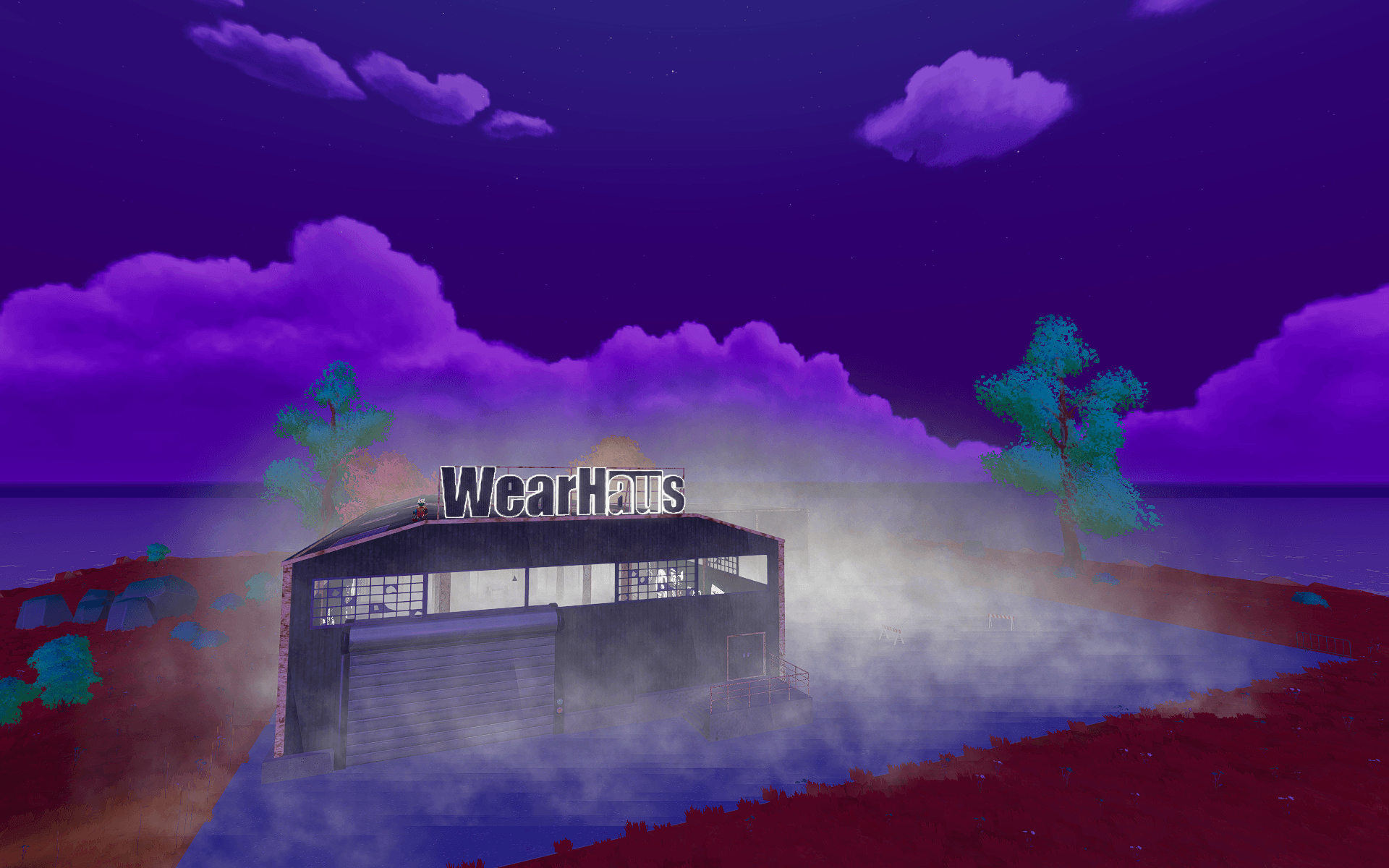
We picked Decentraland SDK7 as the launch platform. Not because it’s perfect — no platform is — but because it gave us the right balance of creative control and accessible distribution. Decentraland was the right starting camp. The roadmap already included Spatial, Portals, Hyperfy, and wherever else the community gathers.
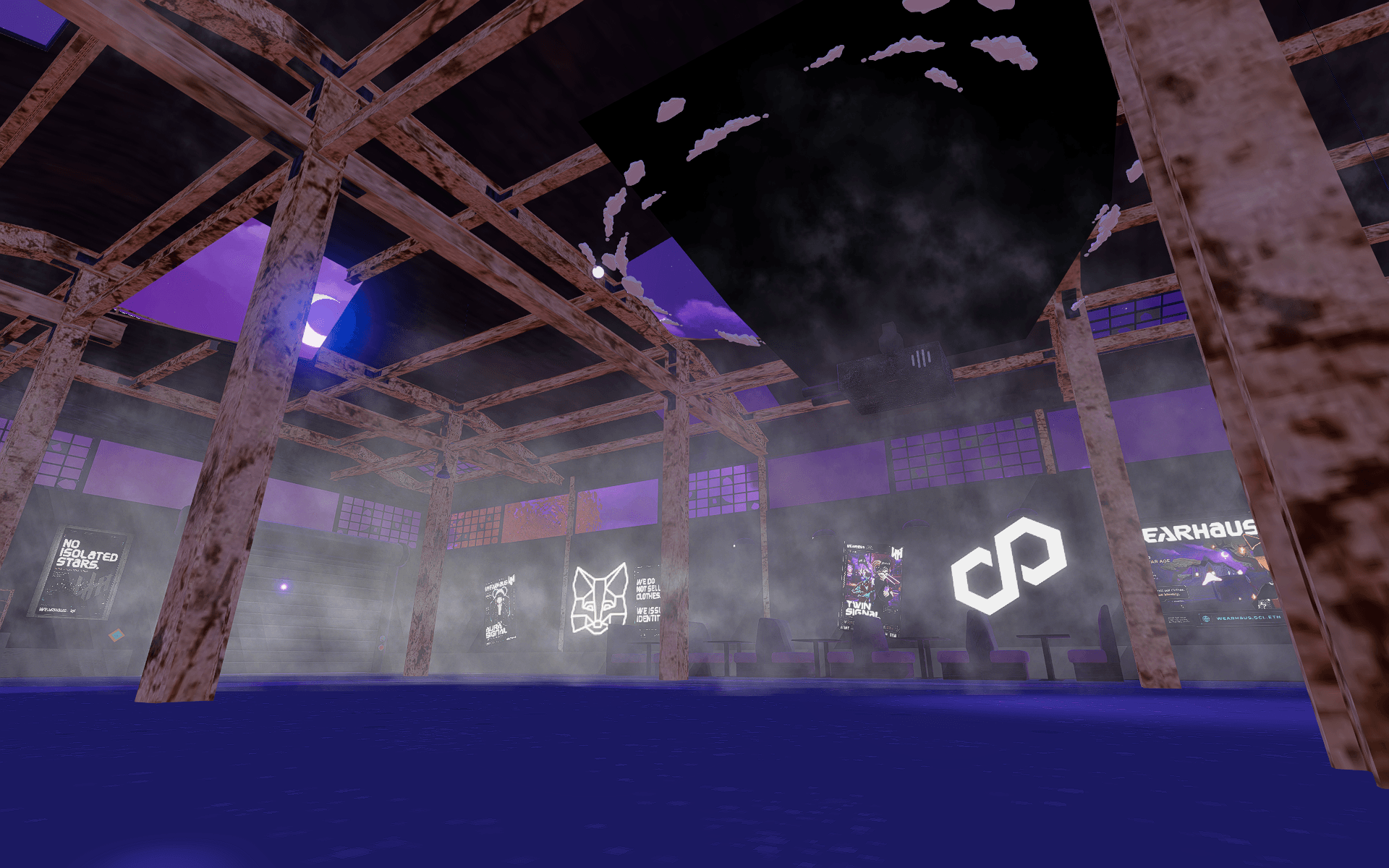
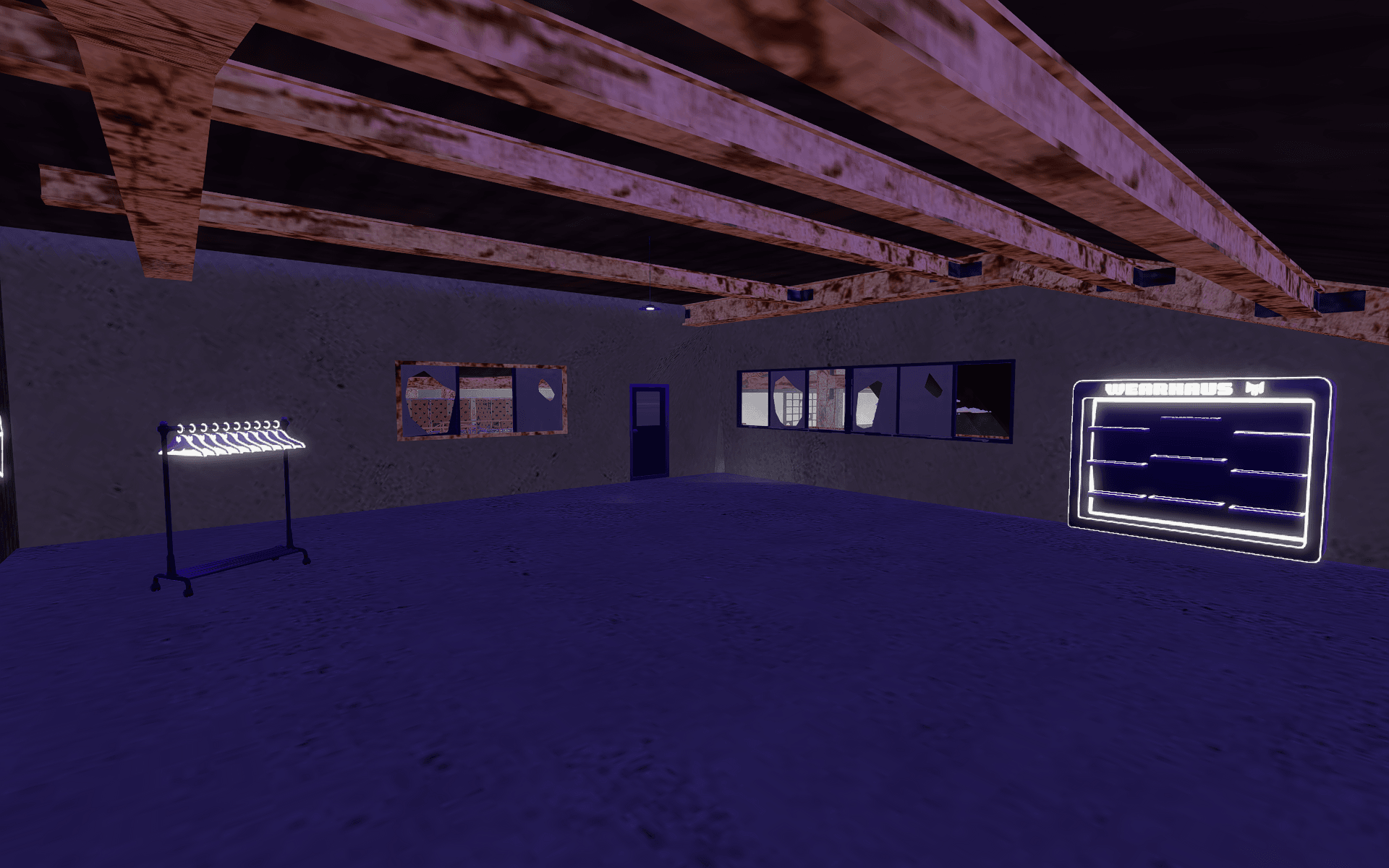
The architecture is modular by necessity. A system, not a sculpture. Distinct zones — main floor, VIP areas, lounge, jumbotron — each swappable and upgradeable. The interior vibe is intentionally raw: exposed structures, poster walls, scattered detail work that rewards wandering.
Every commit below is from the repo. This is the actual build process, in order.
April 28 — Day One
254259e — Initial commit: WearHaus DCL scene with door interactivity
The first line of code. Doors that open and close. That was the entire scope on day one — can we make a door work?
Then: can we make it work well? Door colliders get removed when open so players can actually walk through (de248dc). Doors only open once by default, so we reset animation on replay (f5f9a93). Pointer collision stays on open doors so they can close back (dca46e6). Click detection via invisible trigger entities (e2df86a). Proximity auto-close so doors don’t stay open forever (d843d47). The F key closes doors because E key conflicts with the interaction system (1c2fc80).
By the end of day one, we had a door system that felt reactive. It was just a door. But reactive doors set the tone for everything after.
April 29–30 — Access Control
eb2d577 — Add open/close sounds for LargeDoor entities
Good doors have sound. Ambient warehouse creak, not sci-fi swoosh.
1b76177 — Add VIP-only access control for VIPDoor using DCL name resolution
This was the first piece of identity logic. Some doors should check who you are. The VIP system started as name resolution — literal string matching against DCL names. It’s since evolved, but the principle was there from week one: not everybody gets everywhere.
May 2 — SDK Upgrade and Scene Polish
5f4f8b1 — Update scene: SDK 7.22.5, camera target, voice chat, entity names, composite
SDK 7.22.5 bought us camera targeting and voice chat. The venue could now orient the player and let them talk to each other. Basic social infrastructure.
c3d974c — Add asset packs, audio, models, and project config files
The first asset batch. Concrete textures, warehouse geometry, initial audio loops. The space started feeling like a space instead of a box.
449c2b6 — chore: add editor configurations and scene documentation
AGENTS.md, editor configs, project structure. We were building for collaboration even when it was just two people.
May 4–8 — Atmosphere
e8131fe — feat: enhance lighting system with party and ambient modes
The first mood system. Two modes: ambient (warehouse default, grungy, dim) and party (reactive, brighter, intentional). Toggleable. The venue could now shift personality based on what was happening inside it.
6cdf231 — feat: add Cloud model and update entity names with new assets
Floating environmental geometry. Decorative but dimensional.
17abd78 — feat: add cloud motion functionality and update entity names
Then the clouds moved. Subtle drift motion. The space became alive in a way static venues aren’t.
ff1a3f9 — feat: add new models for wearhausBOOTH and wearhausconcrete, update entity names and thumbnails
DJ booth. Concrete flooring. The functional pieces started arriving.
f8dcef5 — feat: add bathroom cleaning game loop concept and mechanics
A joke that made it into the repo. There is no bathroom cleaning mechanic in the live venue. But at 2am, anything seems possible.
Then a lighting sprint: spotlight packs, click areas, sitting pose colliders (18d961a), lighting fx pass 1 (245dec7), lighting fix 2 (1b86751), ambience fix 1 (b13e9e6), bulb fixes (20f5faa), bulb fix 2 (2f513bf).
May 10–11 — Refactor and Detail
b9751d3 — Refactor code structure for improved readability and maintainability
The first serious refactor. The code had grown fast and messy. We split it into modular components before it became unmaintainable.
0853c15 — Baked posters, in place
Poster art. Environmental storytelling. The walls started talking.
0853c15...0216c23 — feat(scene): add clothesrack and shoesrack models, asset pack updates, inspector UI states
Racks for the gear. Shoes on display. The space started looking like a warehouse that houses something, not just an empty room.
May 14 — Identity Layer (Placeholder)
6dc1dc9 — feat: Add OP Badge Claim Integration and Notification UI
This was the first identity-system commit. At this point, we knew we wanted a drop system. We knew we wanted tiered access. We didn’t yet know how to build it properly. This integration was a prototype — a signal of intent, not the final architecture. The actual drop system (Raffle Manager, Sacred Free Drop mechanics, OP badge API) would come later, built by a specialist who joined the team after this commit.
That specialist’s story is Devlog #2.
May 15 — Controls and Documentation
8acaf18 — feat(ui): add teal button asset and integrate light switch logic
Interactive light switches. Teal button aesthetic. Players could now change the venue’s mood.
3557afb — docs(agents): add comprehensive skill documentation and reference guides
The AGENTS.md file. Documentation for future collaborators. By this point, we were building infrastructure, not just content.
May 19–20 — Lighting as Product
1f8b8b6 — chore(dependencies): update @dcl/js-runtime and @dcl/sdk to version 7.23.3
SDK 7.23.3. Stability and performance.
563f208 — feat: add lighting management system for dynamic rave effects
The lighting system became a management system. Programmatic control, dynamic rave effects. The venue could now perform.
0d34d32 — Add new racks and special crate for enhanced visual representation
More props. More density. More reasons to look around.
f25de32 — feat(rave-effects): add sparkle emitter functionality for enhanced visual effects
Sparkle emitters. Particle effects. The space could now celebrate.
347733e — feat(scene): add speakers and turntable models to WEARHAUS
Speakers. A turntable. The venue had a heartbeat.
32984a0 — refactor(scene): update WEARHAUS assets and implement turntable interaction
The turntable became interactive. Click it, it spins. The DJ booth was now a thing you could use.
May 22 — Hierarchy and Polish
d1a0729 — build(assets): expand WEARHAUS model library and asset packs
Final asset push before launch. More models, more packs, more visual density.
d3f10d3 — refactor(scene): restructure hierarchy and update VIP entity properties
Hierarchy refactor. VIP entity cleanup. The code was ready.
What’s Under the Hood
Platform: Decentraland SDK7 (TypeScript / ECS architecture)
3D Pipeline: Custom Blender → DCL export, optimized for web delivery
Identity: DCL name resolution for VIP gating (prototype)
Lighting: Dual-mode system (Ambient / Party) with programmatic control and particle effects
Props: Interactive turntable, light switches, door systems, sparkles
Architecture: Modular zones — main floor, lounge, VIP, jumbotron — each independently swappable
The architecture is modular by necessity. We’re building a system, not a sculpture.
What’s Live Right Now
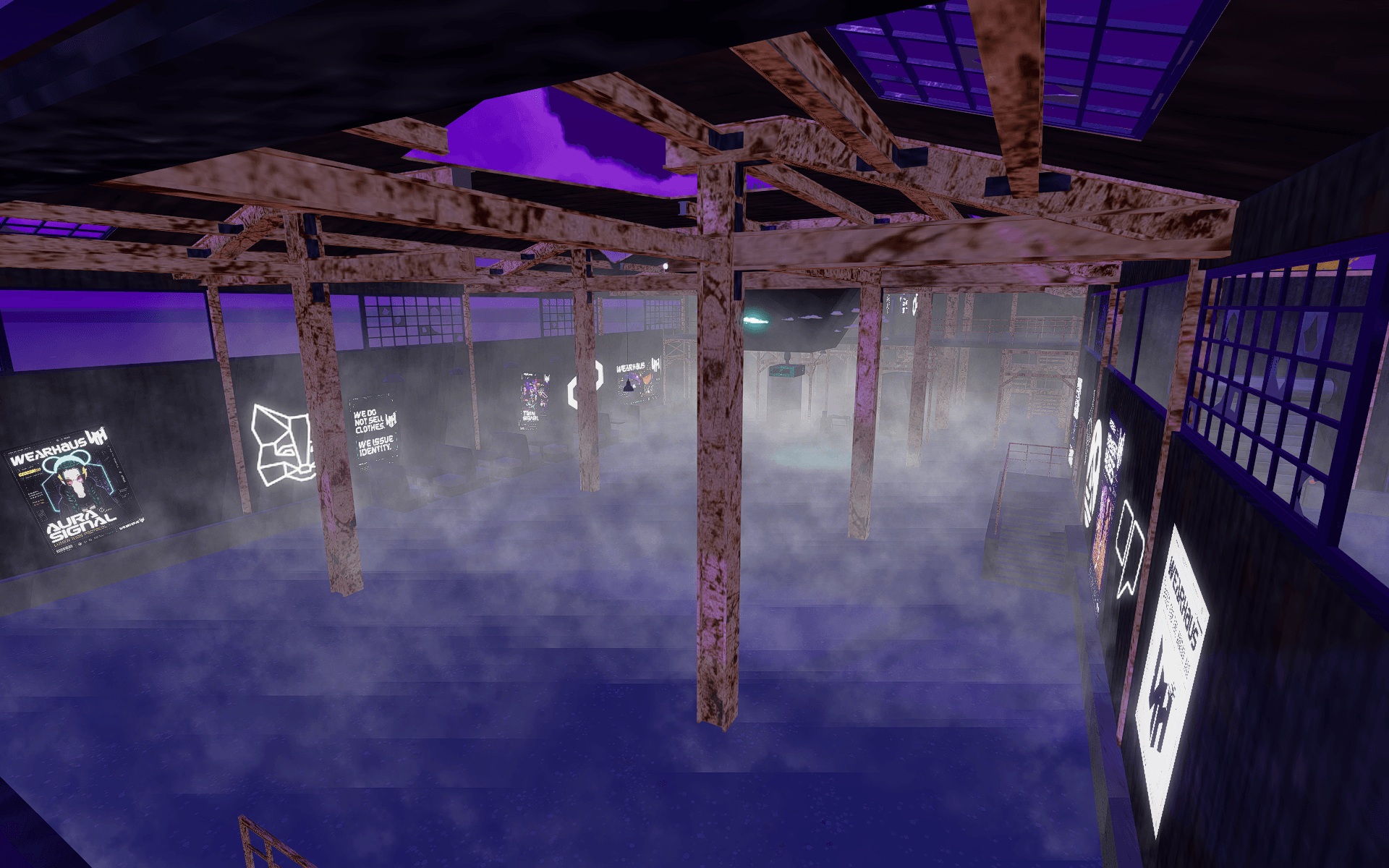
wearhaus.dcl.eth is live: https://decentraland.org/play/world/wearhaus.dcl.eth
Current features:
- Main Floor: Open area for social hangs
- Jumbotron: Large screen for visuals and event broadcasting
- Lounge: Intimate zone off the main flow
- VIP Areas: Tiered access zones (prototype gating, full system coming in Devlog #2)
- Posters & Detail Zones: Art, easter eggs, environmental storytelling
- Interactive Turntable: Click to spin
- Light Switches: Toggle between Ambient and Party modes
- Sparkle Emitters: Celebration effects in Party mode
We’re not calling this “finished” because it’s not supposed to be. The venue is alive.
The Gap
Devlog #1 ends here — the venue built, the systems in place, the code committed. But the story of how WEARHAUS actually launched involves more than what you see above.
The Raffle Manager didn’t exist yet. The OP badge API was a prototype, not a product. The WearHaus Crew Jacket was still in Blender, weights wrong, textures glitching. The Sacred Free Drop system was an idea, not a mechanic.
All of that changed when someone else joined the team.
That’s Devlog #2.
How to Get Involved
Visit the venue. No sign-up needed. Jump into Decentraland at wearhaus.dcl.eth. Walk around. See what’s there.
Follow the devlog series. This is #1 (#0 is the Manifesto). Future posts cover: the specialist who made drops possible, the launch party, and where we’re headed next.
Build alongside us. 3D artists, devs, writers, chaos agents — reach out.
Where We’re Headed
The warehouse was the seed. Worldwide is the goal.
Decentraland is the genesis build. Spatial, Portals, Hyperfy, and other worlds are next. The membership ladder will evolve. The drop system — once it’s built — will expand beyond the Sacred Free Drop into capsules, rituals, blackfiles, and relics.
Not every build decision was correct on the first try. Not every feature shipped smooth. That’s the point. From warehouse to worldwide isn’t a tagline — it’s a process.
If you made it this far, thanks for reading. Now go visit the space, or go build your own thing, or both.
See you at wearhaus.dcl.eth.
— b0gie & 0xQuan
P.P.S. — If you see a floating cat in the venue, that’s not a bug. That’s lore. Leave it. 🤡