This didn’t start in a Google Doc. It started with a barrel, a speaker, and two builders in a reply thread.
— b0gie
Where the Name Came From
April 19, 2026. SHELTER posts a warehouse concept: two industrial barrels, speakers on top, graffiti on the sides. “MUSIC. MAKES. U. WHAT. ARE. WE.” The vibe is raw, unfinished, loud.
Quan replies: “@irb0gie this but in DCL with hyperpop or liquid trap”
I reply: “where//house”
That was it. Two words in a reply thread. No pitch deck, no roadmap, no whitepaper. Just: what if we take this energy and make it travel?
The name came from that reply. WEARHAUS. where + house. The warehouse as a verb, not a noun. Not a place you visit — a framework you wear.
What It Became: The Manifesto
The reply thread was the spark. The whitepaper was the formalization — a 30+ page document we wrote to answer the question: okay, but what IS this, actually?
The condensed version:
WEARHAUS should be understood as a sovereign lifestyle label and culture system for the avatar age: a house that issues identity across physical, digital, and immersive environments while protecting creator ownership at the level of contract, metadata, attribution, and distribution.
That framing is stronger than “metaverse fashion.” The market gap is not “more events” or “more wearables.” It is better culture systems.
Most virtual events are being executed at low aesthetic and behavioral standards: weak venues, diluted music curation, static wearables, unmemorable loops, and little reason to return. WEARHAUS can differentiate by fusing street-tech brand language, touring DJ activations, venue-quality discipline, scavenger-style progression, and wearables that do things.
In this model, digital items are not just cosmetics; they are interfaces, permissions, badges, access keys, and world triggers. The business thesis: memories plus quality create conviction pricing. When the event is well-designed enough to become social proof, the drop becomes more valuable, the wearable becomes more meaningful, and the house becomes harder to imitate.
Cultural Lineage
The strongest fashion houses begin as visible social behavior, become editorial media, and only later stabilize into product systems. That arc runs through:
- FRUiTS (1997) — Shoichi Aoki documenting Harajuku’s experimental street-fashion boom
- A Bathing Ape (1993) — Jun Takahashi and Nigo occupying Ura-Harajuku backstreets
- Yohji Yamamoto, WTAPS, Fragment Design — black-volume rigor, military precision, minimalist symbol weight
- Contemporary: BALMUNG, HATRA, chloma, Cav Empt, ANREALAGE — treating clothing as liminal wear and interface
The lesson: earned myth, legible codes, selective releases, and unmistakable insignia before expansion.
The visual system we formalized: street-tech luxury meets industrial minimalism. Angular wordmark, monogram-level insignia, brutalist grid logic, tactical UI overlays, cyan-and-lime accent signals. The emotional reference is “2040 Tokyo built for avatars and physical reality.”
Three permanent asset families:
- Core: obsidian, white, concrete — premium basics, packaging, labels
- System: cyan HUD language — interactive drops, dashboards, world overlays
- Rare: lime, chrome, occasional red — ritual drops, event-only products, motion-content stingers
Identity as System
Digital identity is no longer culturally marginal. Roblox reported 97.8 million daily active users in Q1 2025, with users updating avatars an average of 274 million times per day. Epic Games said creators inside Fortnite earned $352 million in 2024. VRChat now supports direct creator monetization.
WEARHAUS treats clothing as interface, atmosphere, and behavior system — not just textile form. Every piece is designed across five simultaneous layers:
- Silhouette — stance and body politics
- Surface language — logos, patterns, insignia, serials
- Motion/reactivity — glitch, illumination, BPM response, spatial FX
- Context — the room, event, stream, or environment
- Metadata — creator-of-record, edition, permissions, unlock logic, provenance
A WEARHAUS wearable is not only an outfit. It is a ceremonial interface and a behavior layer.
The Drop System
Scarcity should be legible and disciplined, not gimmicky:
| Drop type | Function | Scarcity logic |
|---|---|---|
| Sacred free drop | Seed belonging and signal affiliation | Time-windowed or event-bound |
| Capsule | Release a compact thematic collection | Limited run or limited claim period |
| Ritual | Bind product to a live event or ceremony | Event-activated, often non-repeatable |
| Blackfile | Surprise release for insiders or scavenger winners | Hidden, invite-based, or location-based |
| Relic | Archive reissue with historical framing | Small run, documented provenance |
Each release specifies why it is limited: artist capacity, event-specific logic, serialized archive policy, or narrative season.
Creator Rights Are Central
WEARHAUS inverts the traditional extractive label pattern. The creator keeps underlying IP. WEARHAUS receives a scoped license based on release type, channel, geography, duration, and adaptation rights. All contributors are listed before launch. Revenue splits are signed before publication.
Commissioned work-for-hire is exceptional, visibly premium-priced, and never hidden inside friendly culture language.
The Event Model
The DJ or streamer is the ignition point, but the product is the system around the performance. The world should become a lightweight extension of what they already do — adding interactive value without turning participation into a chore.
In a WEARHAUS event, a live performance alters lighting, signage, spatial FX, loot timing, access permissions, and world-state progression. Partygoers don’t merely watch. They check in, collect status, unlock routes, and leave with proof they were there.
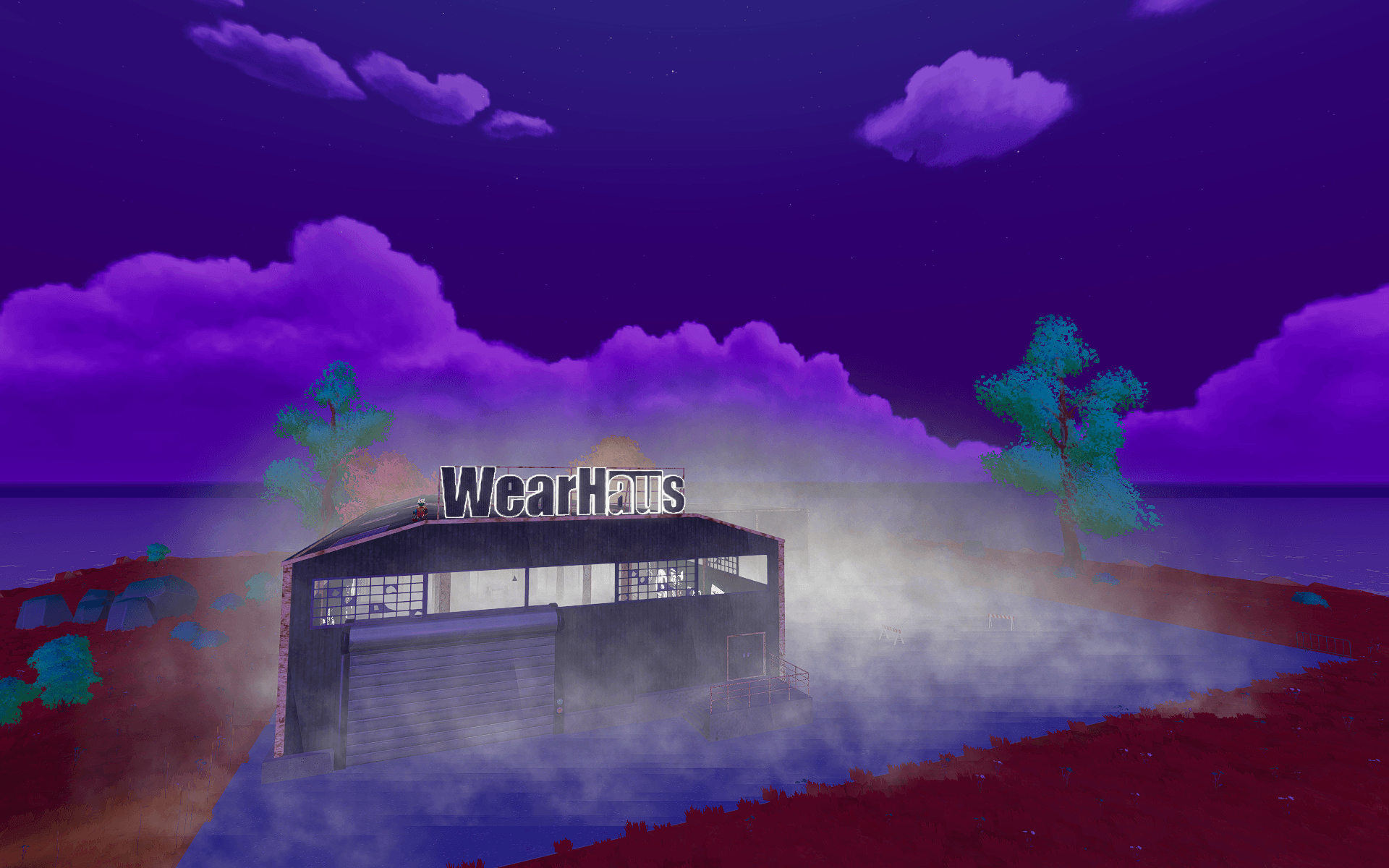
The venue should feel like a restricted-access node, not a leftover demo lot. Darker palettes, architectural intent, legible wayfinding, coherent camera sightlines. Memory quality determines value perception.
Platform Stack (Sequenced)
| Platform | WEARHAUS Role |
|---|---|
| Decentraland | Public-facing touring nodes, scavenger routes, brand activations |
| VRChat | Early flagship for house-coded identity and ticketless ritual events |
| Spatial / Portals / Hyperfy | Flexible pop-up architecture, lower-friction public entry |
| Roblox | Long-term mass reach, modular identity layers |
The house does not chase every platform at once. Culture first, then depth, then leverage.
The Timeline So Far
- April 19: SHELTER posts warehouse barrel concept
- April 20: Quan replies “this but in DCL”; b0gie replies “where//house”; the name exists
- April 20–May 15: Whitepaper drafted, brand bible formalized (Quan’s May 16 post confirms brand agreements, contracts green, OP machine set up)
- April 28: First code commit (wearhaus.dcl.eth)
- May 20–22: Build sprint → launch
The reply thread was the seed. The whitepaper was the translation. The warehouse was the build. The launch was the proof.
WEARHAUS, at its best, is not a merch line or a metaverse novelty. It is a sovereign cultural house that turns identity into a system: designed with precision, staged with memory, and governed with enough seriousness that artists want to build there and audiences want proof they were present.
from a reply thread to worldwide.
— b0gie, on behalf of WEARHAUS
P.S. — Shoutout to SHELTER for the barrels. We saw what you were building. We just wanted to wear it. 🤡
P.P.S. — The full 30-page whitepaper is here. This post is what it felt like before it had footnotes.